

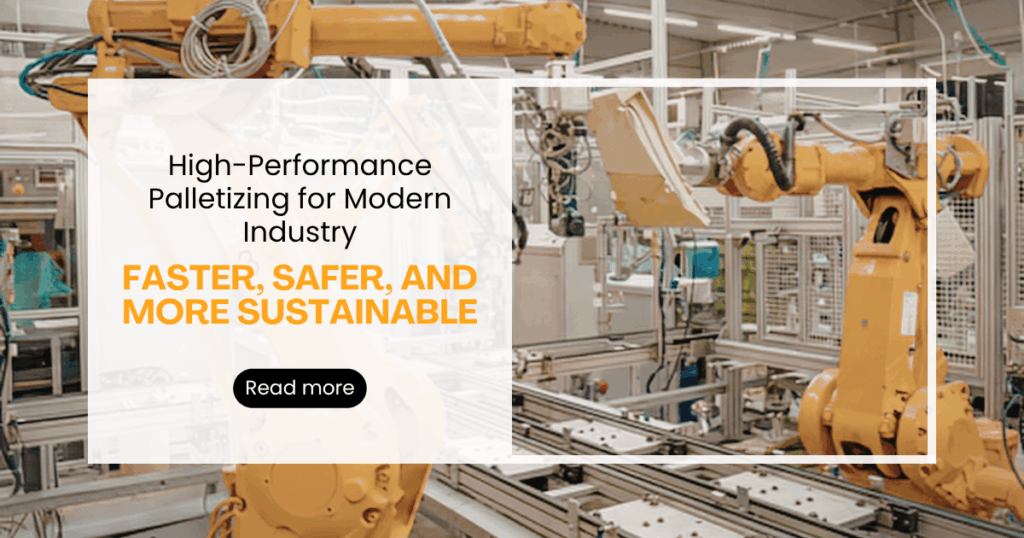
High-Performance Palletizing for Modern Industry: Faster, Safer, and More Sustainable
The final meters of a production line are among the most critical – and, historically, the most overlooked. Palletizing, the process of stacking and organizing finished goods onto pallets for storage and transport, has long been dominated by manual labor: repetitive, physically demanding, and limited in throughput. But that model is changing fast. Driven by labor shortages, rising operational costs, and the imperative to build more resilient supply chains, manufacturers across every sector are turning to automated and robotic palletizing systems. The results speak for themselves: greater speed, dramatically improved workplace safety, measurable sustainability gains – and a return on investment that often materializes within months.
At Hilltechs, we work with manufacturers and logistics operators to build end-of-line packaging solutions that are engineered for performance. In this article, we explore what is driving the shift to high-performance palletizing – and why now is the right time to make that move.
The Business Case: Why Manual Palletizing No Longer Scales
Manual palletizing is not simply slow – it is a structural liability. Operators lifting and stacking heavy cases repeatedly across eight-hour shifts face serious ergonomic risk. Back injuries, shoulder strain, and musculoskeletal disorders are among the most common – and costly – workplace injuries in manufacturing and logistics. Beyond injury risk, manual operations introduce variability. Inconsistent stack patterns lead to unstable pallet loads, damaged goods, and complications in warehouse storage and shipping.
Labor availability compounds the problem. Across manufacturing regions globally, filling repetitive end-of-line positions remains persistently difficult. High turnover rates increase training costs and disrupt production continuity. Automation provides a way out of this cycle – and the numbers reflect growing adoption. The global palletizing robot market is valued at approximately USD 1.6 billion in 2025 and is projected to exceed USD 2.7 billion by 2035, growing at a compound annual rate of around 5 to 6 percent.
Speed and Throughput: Machines That Never Slow Down
Modern robotic palletizers operate continuously – 24 hours a day, seven days a week – without fatigue, breaks, or the productivity dips that inevitably occur during long manual shifts. Automating palletizing can increase output by up to 40 percent with the same number of employees, freeing human operators for higher-value tasks rather than eliminating them entirely.
Robotic systems also deliver consistent pallet quality. Every stack is built to specification, with uniform weight distribution and load integrity – reducing product damage during transit and improving downstream efficiency in warehousing and distribution. In one documented implementation at a distribution and fulfillment center, an automated palletizing system eliminated the manual requirement for five employees per shift across three shifts and seven days a week, resulting in a net labor savings of 12 employees and a rapid return on investment.
Modern systems are also highly flexible. Today’s articulated-arm robots and collaborative palletizers (cobots) can handle a wide variety of product types – cases, bags, pails, drums – and be reprogrammed rapidly to accommodate new SKUs or pallet configurations. No-code palletizing software and plug-and-play capabilities mean companies can incorporate automation into their workflows in hours rather than days.
Safety: Removing People from the Highest-Risk Motions
End-of-line palletizing is one of the most physically hazardous points in any production environment. Cases, bags, and drums move constantly. Forklifts weave through the same operational space. Workers repeat the same movements hundreds of times per shift. Automated palletizing removes people from those high-risk motions – fundamentally changing the safety profile of the workspace. Modern palletizing robots are engineered with layered safety architectures – light curtains, safety-rated controllers, area scanners, and guarding systems that allow operators to interact with equipment without unnecessary exposure to hazards. Collaborative robots, or cobots, take this further by design: they are engineered to work safely alongside human workers without traditional guarding infrastructure, making them ideal for facilities with constrained space or where human operators still need to be involved in part of the palletizing process.
The business benefits of improved safety extend directly to the bottom line. Fewer workplace injuries mean fewer workers’ compensation claims, lower insurance premiums, less downtime, and a more productive, more loyal workforce. Regulatory compliance also becomes easier to maintain when physical risk is systematically engineered out of the process.
Sustainability: Automation as an Environmental Strategy
High-performance palletizing is not only a productivity story – it is increasingly an environmental one. Automated systems contribute to sustainability goals in several interconnected ways. Precise, consistent pallet stacking reduces product damage in transit, which in turn reduces waste – both material waste and the carbon cost of replacements and returns. Automated stretch wrapping systems, integrated with robotic palletizers, apply film with optimized tension and coverage, consuming up to 30 percent less film than manual wrapping while providing superior load stability.
The integration of Internet of Things sensors and cloud-based management systems into modern palletizing lines enables real-time monitoring of energy consumption, material usage, and throughput efficiency. This data empowers operators to identify inefficiencies, reduce energy waste, and demonstrate measurable progress against sustainability commitments – increasingly important for organizations subject to environmental reporting requirements or customer-driven ESG expectations.
Sustainable packaging materials also play a role here. At Hilltechs, we supply a comprehensive range of transport and pallet protection solutions – from nano stretch films and stretch hood films to eco-conscious paper-based alternatives – designed to work seamlessly with both manual and automated end-of-line systems. Choosing the right consumables in combination with the right equipment is where real efficiency gains are made.
ROI and Implementation: A Decision Built on Evidence
For many operations, the hesitation around automation centers on capital expenditure. But the financial case for robotic palletizing has never been stronger – or more clearly evidenced. Return on investment timelines have compressed significantly as system costs have declined and labor costs have risen. Cobot deployments in particular have demonstrated ROI periods as short as nine months in documented case studies across food and beverage copacking operations.
When calculating ROI, it is important to account for the full cost picture: direct labor savings; reduced recruitment, training, and turnover costs; lower workers’ compensation expenditure; fewer product losses from damaged loads; and the productivity gains from running multiple shifts without incremental labor cost. In most medium-to-high-volume operations, these factors combine to make automation a genuinely compelling investment – not a luxury.
Modular system design has also reduced the barrier to entry. Facilities do not need to automate everything at once. Scalable palletizing solutions allow operations to begin with a single robotic cell, validate the ROI in practice, and expand from there. Integration with existing conveyor infrastructure and warehouse management systems is increasingly straightforward, with modern systems designed to communicate with ERP and WMS platforms from day one.
Sector Applications: Who Benefits Most?
High-performance palletizing delivers measurable value across a broad range of industries, but certain sectors stand to gain most immediately:
Food and beverage: High-volume, mixed-SKU environments where throughput and hygiene compliance are both critical. Robotic palletizing paired with track-and-trace capabilities supports traceability requirements and food safety standards.
Pharmaceuticals: End-of-line automation enables pharmaceutical manufacturers to meet strict serialization and regulatory requirements while maintaining the precision handling that sensitive products demand.
E-commerce and fulfillment: The explosive growth in online retail has driven demand for automated solutions capable of handling thousands of unique product placement patterns in real time, adapting to dynamic order profiles without costly reconfiguration.
Contract packaging: AI-powered palletizing robots allow contract packagers to handle irregular or mixed loads today and seamlessly transition to new formats tomorrow – without the downtime or capital cost of reconfiguration.
The Hilltechs Perspective: Complete End-of-Line Solutions
Palletizing automation does not exist in isolation. At Hilltechs, we provide the complete ecosystem – stretch films, stretch hood solutions, corner boards, anti-slip systems, strapping equipment, and wrapping machinery – that ensures palletized loads perform from end of line to final destination. Our system integration services mean we do not simply supply products; we engineer solutions.
The shift to high-performance palletizing is no longer a question of if – it is a question of when. The time to act is now.

Related posts
Integrating Process Automation and Palletizing for Efficient Industrial Production
Modern industrial facilities are under relentless pressure to produce more, wast
Robotic vs. Conventional Palletizing: Which Solution Is Right for Your Business?
Manufacturers evaluating robotic and conventional palletizing often look for a s