

Integrating Process Automation and Palletizing for Efficient Industrial Production
Modern industrial facilities are under relentless pressure to produce more, waste less, and do it all with fewer errors. For operations managers and production engineers, the answer increasingly lies at the intersection of two powerful forces: process automation and automated palletizing. When these two disciplines are properly integrated, the result is an end-to-end production environment that is faster, safer, and significantly more cost-effective.
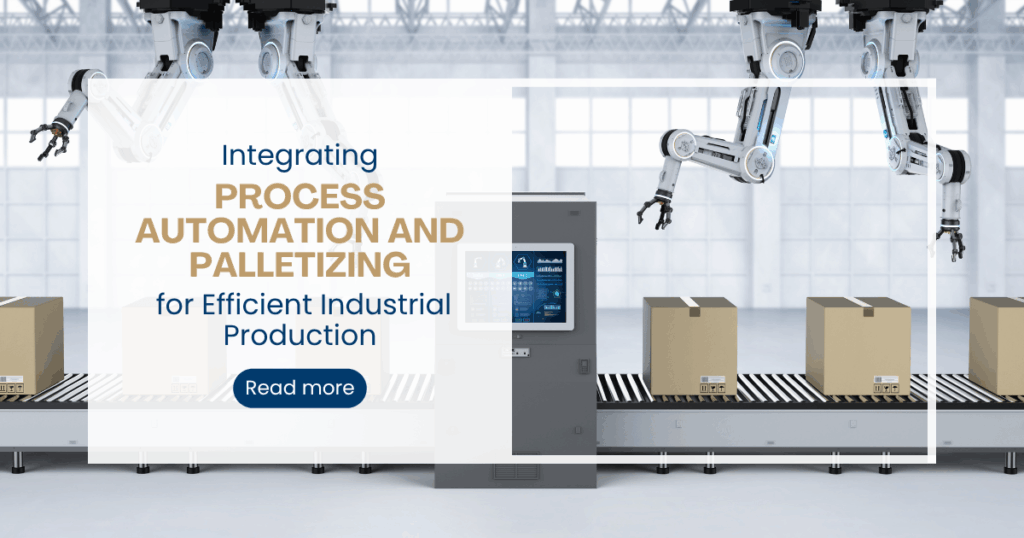
The Case for Integration: Why Siloed Automation Falls Short
Many facilities have invested in automation piecemeal – a robotic arm here, a conveyor upgrade there. But disconnected systems create bottlenecks. A high-speed filling line that feeds a manual palletizing station, for instance, becomes a productivity ceiling, not a production asset.
True efficiency emerges when upstream process automation – including case erecting, filling, sealing, and labeling – connects seamlessly with end-of-line palletizing. This unified approach eliminates handoff delays, reduces the risk of human error, and enables real-time data to flow across the entire production chain.
Studies suggest that a significant share of manufacturing downtime and product defects can be linked to human factors, especially in environments with manual handling and disconnected systems. Synchronizing machines and people through smart automation directly addresses these hidden costs.
How Process Automation Lays the Groundwork
Process automation encompasses everything from how a product is formed and filled to how it is packaged and coded before it ever reaches the palletizer. Key technologies include:
– Case erectors and sealers that consistently form and close secondary packaging at line speed
– Conveyor systems with smart routing to manage product flow across multiple lines
– Vision and sensor systems that inspect, verify, and reject non-conforming products before they move downstream
– MES (Manufacturing Execution Systems) and SCADA platforms that orchestrate and monitor the entire process in real time
When these elements work together under a unified control architecture – increasingly enabled by what the World Economic Forum calls Software-Defined Automation (SDA) – manufacturers gain the ability to adapt production rapidly through software rather than costly hardware reconfigurations. This flexibility is critical in today’s environment of frequent SKU changes and shifting customer demands.
The Palletizing Imperative
At the end of every production line, products must be stacked, stabilized, and made ready for shipping. Manual palletizing is physically demanding, inconsistent, and increasingly difficult to staff. Automated palletizing solves all three problems. Modern palletizing solutions – including robotic palletizers, layer palletizers, and cobot (collaborative robot) systems – offer compelling operational advantages:
– Speed and consistency: Robotic palletizers can operate continuously without fatigue, maintaining stacking accuracy across entire shifts
– Worker safety: Eliminating repetitive heavy lifting reduces musculoskeletal injuries and lost-time incidents
– Flexibility: Robotic systems with vision-guided end-of-arm tooling can handle mixed SKUs, varying case sizes, and complex pallet patterns without full line stoppages
– ROI: Industry case studies show that automated palletizing cells can significantly reduce end-of-line labor requirements while increasing throughput and improving overall line efficiency within a relatively short time after installation.
For operations running diverse product mixes – from cartons and bags to shrink-wrapped trays – robotic palletizers offer the greatest configurability. High-volume uniform lines may be better served by conventional layer palletizers, which deliver exceptional speed and load stability.
Seamless Integration: Connecting the Line End to the Line Start
The real productivity gains emerge when palletizing is not an afterthought but a designed component of the broader automation ecosystem. Effective integration involves:
- Conveyor and Infeed Synchronization
The palletizer must receive products at the right rate, orientation, and spacing. Properly designed infeed conveyors, diverters, and accumulators ensure the palletizer is never starved – and never overwhelmed.
- Stretch Wrapping and Pallet Handling
A complete end-of-line system extends beyond stacking. Integrated stretch wrappers, pallet dispensers, slip-sheet applicators, and pallet conveyors form a turnkey flow that moves finished loads to staging or dispatch with minimal manual intervention.
- MES and WMS Connectivity
Modern palletizers interface with plant-level systems via standard industrial protocols (such as Ethernet/IP and ProfiNet), enabling automatic pallet label generation, lot tracking, and inventory updates. This connectivity removes paper-based processes and the errors that accompany them.
- Predictive Maintenance and Uptime Monitoring
Smart sensors embedded in conveyor drives, robot joints, and wrapping units generate continuous data on equipment health. This allows maintenance teams to schedule interventions before failures occur – a critical advantage for operations where unexpected downtime cascades across an entire integrated line.
Choosing the Right System for Your Operation
No two production environments are identical. Key considerations when evaluating an integrated automation and palletizing solution include:
– Product characteristics: Weight, dimensions, fragility, and packaging format all influence the choice of palletizer type and end-of-arm tooling
– Throughput requirements: Cases per minute (CPM) targets determine whether a robotic system, a high-speed conventional palletizer, or a cobot solution is most appropriate
– Floor space: Compact robotic cells can be configured for tight layouts, while conventional systems may require dedicated floor areas
– SKU variability: Operations with frequent changeovers benefit most from robotic flexibility and software-driven pallet pattern programming
– Growth trajectory: Modular, scalable systems protect capital investment by accommodating future line additions without full redesigns
Building a Smarter Production Line From the Ground Up
At Hilltechs, we deliver complete end-of-line automation solutions – from case erectors and conveyor systems to robotic and conventional palletizers, stretch wrappers, and stretch hood systems. We support integrated systems built to your specific product mix, throughput goals, and facility constraints. Whether you are taking your first steps into automation or optimizing an existing line, Hilltechs brings the expertise, the technology, and the local support to make integration work.

Related posts
Robotic vs. Conventional Palletizing: Which Solution Is Right for Your Business?
Manufacturers evaluating robotic and conventional palletizing often look for a s
High-Performance Palletizing for Modern Industry: Faster, Safer, and More Sustainable
The final meters of a production line are among the most critical – and, histo