

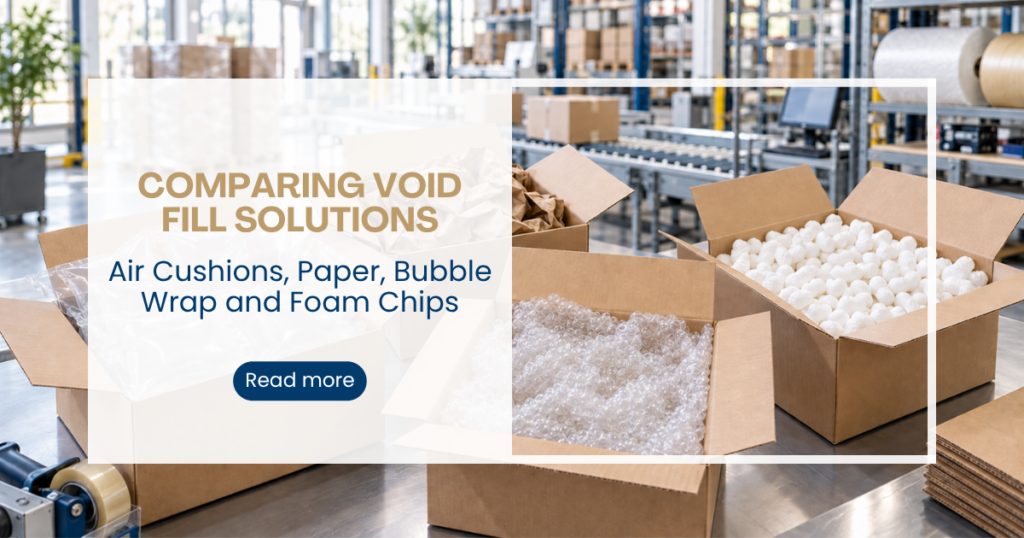
Comparing Void Fill Solutions: Air Cushions, Paper, Bubble Wrap and Foam Chips
Product movement inside a shipping carton can lead to impact damage, abrasion, and displacement even when the outer box remains intact. Void fill solutions reduce empty space and help keep products stable throughout handling, storage, and transportation.
This article compares air cushions, paper void fill, bubble wrap, and foam chips to help businesses identify a suitable solution based on product characteristics, packing requirements, storage capacity, and sustainability objectives.
What Void Fill Actually Does, and What It Does Not
It helps to separate two distinct jobs inside a carton. Void filling reduces empty space so the contents are less likely to move. It is primarily a stabilization function that can help limit repeated low-energy impacts throughout a shipment.
Cushioning absorbs shock and vibration transmitted through the box wall to the product and can protect finished surfaces from abrasion. It is primarily an energy-management function. Some materials perform one job well, while others can contribute to both. Confusing the two may lead to packaging that does not provide the intended protection. A product wrapped carefully in cushioning but left loose inside an oversized box may still be damaged. A tightly packed box can restrict movement, but the selected material must also provide the level of cushioning the product requires.
A basic manual check can reveal obvious movement after a carton is sealed, but it cannot confirm that a package will withstand the full distribution environment. Fragile, high-value, or technically sensitive products should be evaluated using appropriate packaging tests that reflect expected handling and transport conditions.
Air Cushions: Low Weight, Compact Storage, and Efficient Output
Air cushions, also called air pillows, are inflated on demand at the packing station from flat rolls of film. The Hilltechs Air Bag Machine inflates and seals the film into a continuous chain of cushions that operators can separate and place into a carton. These in-box air cushions should not be confused with dunnage airbags, which are used to secure cargo during transport.
Where they perform well
Air cushions add very little material weight to a parcel because most of their volume is air. This can help limit increases in actual shipping weight, although the final freight charge will still depend on the carrier’s pricing model and whether actual or dimensional weight applies.
Flat film rolls require less storage space before use than pre-inflated cushioning materials. This can be valuable where packing-station or warehouse space is limited.
Air cushions can also support efficient packing. Because the material is produced at the station and does not require manual crumpling, operators can dispense and place it quickly. Hilltechs’ air bag machine produces cushions at up to 60 feet (18 meters) per minute, with adjustable air volume and production speed and an optional foot pedal for hands-free operation.
Paper Void Fill: Firm Support and Familiar Recovery Routes
Paper void fill typically uses kraft paper dispensed from rolls or fanfold stacks and crumpled, folded, or converted to fill space around a product. Hilltechs offers kraft void paper within its filler range, as well as Ranpak Paper for cushioning, wrapping, void filling, blocking, and bracing applications.
Where it performs well
Paper can perform well in blocking and bracing applications when the appropriate grade and amount are used. Densely converted or crumpled paper can help hold heavier components in position, while the required configuration depends on product weight, geometry, and transport conditions.
Paper is commonly accepted through paper recovery streams, but recyclability depends on coatings, contamination, local collection rules, and the specific paper product. For businesses seeking to reduce plastic content or simplify material separation, paper void fill can be a practical option when it provides the required protection.
The material cost depends on paper grade, basis weight, conversion method, purchase volume, and the amount required for each package. These factors should be assessed alongside labor, storage, freight, and damage-related costs.
Bubble Wrap: Surface Cushioning for Fragile and Irregular Items
Bubble wrap is a plastic film containing air-filled cells. Its primary role is cushioning and surface protection. It is usually wrapped directly around a product so the trapped air can absorb shock and vibration while the film separates the product surface from surrounding materials.
Where it performs well
For fragile goods with irregular geometry, such as glassware, ceramics, instrumentation, or assemblies with protruding features, bubble wrap can conform to the product and provide cushioning across its surface. Multiple layers may increase protection, while bubble size and the number of layers should be selected according to the product and expected handling conditions.
Bubble wrap can also be folded or placed into smaller gaps as supplementary void fill. This can make it a flexible option for lower-volume operations, although it may be inefficient when used to fill large empty spaces.
Where the material remains clean and undamaged, it may be retained and reused. Its suitability for reuse should be checked before it is placed around another product.
Foam Chips: Conforming Fill for Irregular Voids
Foam is available in several packaging formats with different properties. This comparison focuses on foam chips, also known as loose-fill foam or packing peanuts, because this is the foam-based filler listed in the Hilltechs product range.
Foam chips are lightweight, interlocking pieces that flow around products and fill irregular spaces within a carton. Their primary role is void filling, with additional cushioning against shocks and vibration.
Their ability to surround irregular shapes can be useful for mixed-product packing where product dimensions vary and a formed insert is not practical.
Hilltechs states that its foam fillers are reusable and recyclable. In practice, reuse and recycling depend on the material remaining clean and undamaged and on the recovery options available in the destination market.
Where it performs well
Foam chips require no inflation or paper-conversion equipment and can be placed around products with irregular shapes. This can suit high-mix or lower-volume operations where packaging requirements change frequently.
Because the chips interlock, they can help restrict movement while providing lightweight cushioning. The quantity and packing density still need to be matched to the product, carton, and expected transport conditions.
They may also be suitable for closed-loop applications where the receiver can collect and reuse the material, provided it remains clean and retains its protective properties.
Matching Void Fill to the Damage Mode You Are Trying to Prevent
Instead of looking for one material that is best in every situation, identify the damage mechanism or packaging weakness and evaluate the available materials against it.
- Products arriving with impact damage but little visible abrasion may indicate insufficient cushioning, excessive movement, or both. Bubble wrap, paper cushioning, or an appropriate foam solution may be considered after the cause has been assessed.
- Scuffing, scratching, or abrasion may point to contact between the product and its packaging or between separate items. Direct surface protection, improved separation, and more effective stabilization may all be relevant.
- Heavy items that shift within a carton may require stronger blocking and bracing. Densely converted paper or a product-specific protective structure may be more appropriate than lightweight air cushions, subject to testing.
- Lightweight items in oversized cartons may indicate a right-sizing issue. Reducing unnecessary carton volume can lower the amount of fill required and improve product stability.
- Damage patterns that vary by season, route, or storage environment should be investigated for possible exposure to moisture, temperature changes, vibration, or handling differences before the packaging material is changed.
Sustainability Beyond the Material Label
Paper may be accepted through more familiar recovery streams than flexible films or foam, but actual recyclability depends on the product and local infrastructure. Material mass, recycled content, reuse, product protection, and disposal routes should all be considered when evaluating environmental performance.
Air cushion systems can create a large volume of fill from a relatively small amount of flat film, helping limit packaging weight and storage requirements. Paper generally adds more weight than air cushions, while clean foam chips may be reused in suitable operations. A complete environmental comparison still depends on the specific materials, transport distances, recovery systems, and number of use cycles.
Practical sustainability gains come from using an appropriate amount of material while maintaining the required protection. Reducing packaging without validating performance can increase product damage, returns, replacement shipments, and associated resource use.
Combining Materials Instead of Choosing One
In some applications, higher-value or fragile products benefit from more than one material used in clearly defined roles: a cushioning or surface-protection layer in direct contact with the product and a void fill material around it to restrict movement.
A layered approach might use bubble wrap around a fragile component with air cushions filling the remaining volume, or paper cushioning combined with additional surface protection where needed. Combining materials can provide more appropriate protection than asking one material to perform every function, but the final configuration should be validated for the product and distribution environment.
Building Void Fill into Your End-of-Line Process
Void fill selection is rarely an isolated decision. It interacts with carton sizing, packing station layout, labor planning, storage capacity, and the automation level of the end-of-line process. A material that performs well in a trial can underperform in production if the packing station is not set up to apply it consistently, or if throughput requirements exceed what manual application can sustain.
A practical approach is to define the protection requirement based on product characteristics and observed damage patterns, evaluate materials against packing speed, storage, freight, and sustainability constraints, and then validate the selected configuration with suitable drop, vibration, compression, or transport testing before wider implementation.

Related posts
Palletizing mistakes that cost you money – and how to avoid them
Palletizing is one of those behind-the-scenes processes that most people never t
Why “recyclable” cartonboard isn’t always recyclable
As sustainability expectations rise and packaging regulations tighten across Asi

The future of packaging: Embracing green materials
Packaging today does much more than just protect products. In our rapidly changi