

The Hidden Cost of Manual Pallet Wrapping – and the Business Case for Automating It
Why the last three minutes of your packaging line deserve a capital budget line, not an afterthought
Ask most technical directors to rank their automation priorities, and pallet wrapping tends to land near the bottom. Palletizers get attention because they’re visibly the bottleneck. Robots get attention because they’re the exciting purchase. Wrapping gets whatever’s left – usually a turntable machine bought years ago, or a person with a hand-held film roll walking the same loop for an entire shift.
That ranking is backwards. Wrapping is the last thing that touches a pallet before it leaves your control, and it is one of the highest-variance, most quietly expensive steps on the entire line. This article makes the numbers case for moving it up the list.
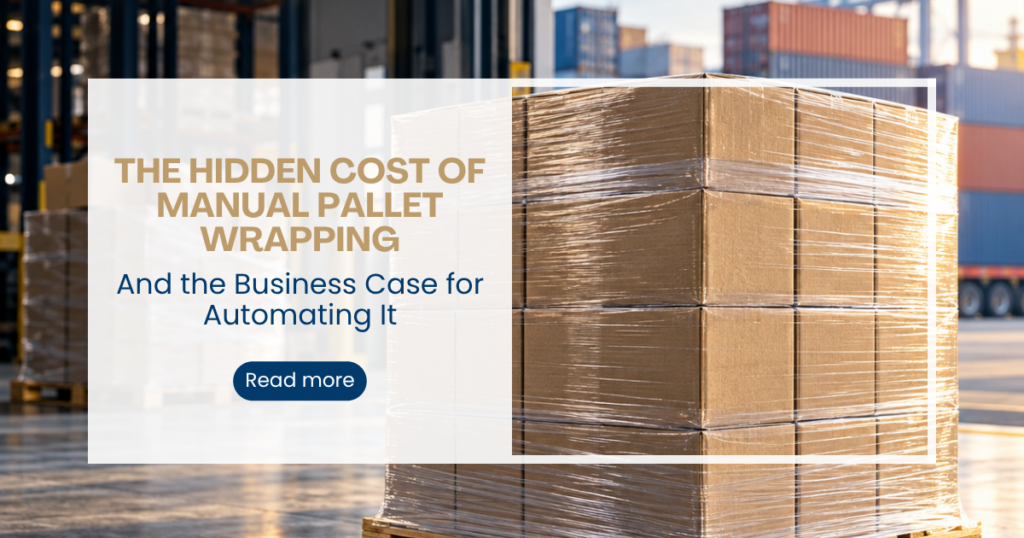
Three ways manual wrapping loses you money every single day
Manual and basic semi-automatic wrapping create three compounding costs, and none of them show up as a single obvious line item.
- Film waste: without pre-stretch control, film gets applied inconsistently – too much in some spots, not enough in others – because tension depends entirely on the operator’s technique and fatigue level that day.
- Load instability: inconsistent wrap tension is a direct cause of loads loosening and toppling in transit, which our own review of common palletizing mistakes identified as a recurring driver of damage claims.
- Throughput drag: wrapping is one of the few stations where the line’s speed is set entirely by one person’s pace, on a task that adds no product value and offers no upside to doing it faster by hand.
Individually, each of these looks like a minor operational inefficiency. Together, across a full year of pallets, they are a real number on the P&L – it’s just spread across three different budget lines (materials, freight claims, and labor), which is exactly why it rarely gets addressed as one problem.
The film math is more dramatic than most CFOs expect
This is the part of the business case that tends to change minds fastest, because it’s concrete and testable.
- Automated pre-stretch wrapping systems can lower film usage by up to 50% compared to manual application, by stretching film up to 250% of its original length before it ever touches the load.
- In one documented example at roughly 20 pallets per day, automating wrapping produced combined annual savings of $10,400 – $7,800 in film cost and $2,600 in labor cost – with the pre-stretch upgrade alone paying for itself in as little as 4 months, and the full machine paying back in 14 months.
- At higher volumes, that payback compresses further – the same analysis shows pre-stretch upgrades paying back in as little as 1 month at 100 pallets per day.
Run that math against your own daily pallet count, and wrapping stops looking like a maintenance-budget line item. It starts looking like one of the faster-payback automation investments available on the entire floor – often faster than the palletizer everyone assumed was the priority.
It’s not just about film – it’s about what arrives intact
Film savings get the attention because they’re easy to calculate. The damage-prevention side of the case is less visible but often larger.
Overhang and misalignment on a pallet can reduce its compression strength by up to 30%. Inconsistent wrap tension is one of the most common ways that instability actually turns into a load failure in transit.
A wrapping system with automatic load-height detection, consistent tension control, and repeatable wrap patterns removes the single biggest variable in whether a pallet arrives the way it left your dock. That’s not a film-cost conversation – it’s a freight-claims, customer-relationship, and brand-reputation conversation, and it tends to matter far more to the customer receiving the shipment than anyone in your own building.
Choosing the right system for your operation
Not every plant needs the same wrapping architecture. The decision generally comes down to three configurations:
- Turntable wrappers rotate the load on a platform – a solid fit for lighter, stable loads and moderate throughput.
- Rotating-arm systems, like the Goldpack AOP Sigma FX, wrap a stationary load instead – the better choice for heavy, unstable, or unusually shaped loads that shouldn’t be rotated. The Sigma FX runs up to 120 pallets per hour, with a 200% power pre-stretch system, automatic load-height detection, and Siemens S7 PLC control for up to 10 programmable wrap cycles.
- Horizontal wrappers handle long or irregular loads (pipes, timber, profiles) that don’t fit a standard vertical wrap cycle at all.
The right choice depends on your load profile, not on which system looks most advanced in a spec sheet. A rotating-arm machine sized for heavy industrial loads is the wrong investment for a light, high-mix e-commerce operation, and vice versa.
Sustainability and performance aren’t a trade-off here
One objection we hear often: “We’re trying to reduce plastic use, not optimize how we use it.” Automated wrapping and sustainable film aren’t competing goals – they’re complementary. ISCC-certified recycled-content stretch film engineered for high stretchability performs reliably on automated pre-stretch systems, meaning plants can reduce virgin plastic use and reduce total film consumption at the same time, without compromising load containment.
For any technical director building a case that also has to satisfy an ESG target, that combination is worth leading with, not treating as a separate initiative.
Building the case for budget approval
If you’re taking this to a capital review, the strongest version of this case has four parts, in this order:
- Your current daily or weekly pallet volume, and what manual wrapping is costing in film alone at that volume.
- Your damage-claim and rework history over the last 12 months, with a reasonable estimate of how much traces back to wrapping inconsistency.
- A payback timeline calculated against your own volume, not an industry average – the range runs from roughly 1 month to well over a year depending on throughput.
- The safety and labor angle: fewer repetitive strapping and wrapping tasks, less operator fatigue, and a station that doesn’t depend on one person’s technique that day.
That combination (hard film-cost numbers, damage-claim history, a realistic payback window, and a safety case) is what turns a wrapping machine from a maintenance-budget request into an easy capital approval.

Related posts
Integrating Process Automation and Palletizing for Efficient Industrial Production
Modern industrial facilities are under relentless pressure to produce more, wast
End-of-Line Automation Isn’t a Line Item. It’s a Resilience Strategy.
What CEOs and technical directors actually need to know before the next capital
Robotic vs. Conventional Palletizing: Which Solution Is Right for Your Business?
Manufacturers evaluating robotic and conventional palletizing often look for a s