

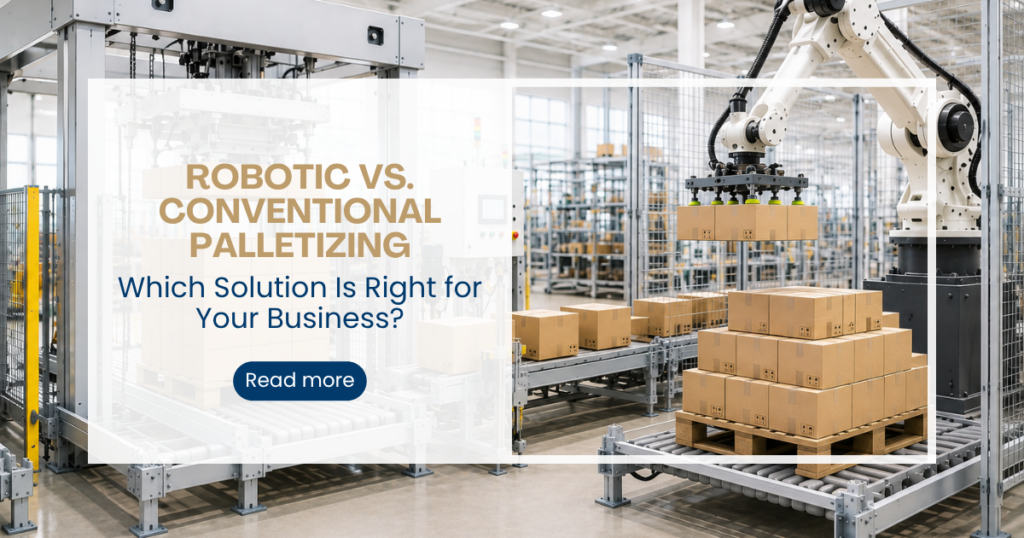
Robotic vs. Conventional Palletizing: Which Solution Is Right for Your Business?
Manufacturers evaluating robotic and conventional palletizing often look for a single answer to which technology is better. In reality, the most effective solution depends on the specific production environment. Neither robotic nor conventional palletizing is universally superior – each offers distinct advantages depending on production volume, SKU variety, product characteristics, facility layout, and long-term operational goals. Rather than comparing technologies in isolation, manufacturers achieve better long-term results by selecting the system that aligns with their production requirements. This article explains how both technologies work, highlights their key operational differences, and explores the factors that should guide an informed investment decision.
Why There Is No Universal “Best” Palletizing System
Manufacturers often compare robotic and conventional palletizing as though one technology should outperform the other in every situation. In practice, palletizing systems are designed to solve different operational challenges. Production volume, product variety, pallet configurations, available floor space, and long-term business goals all influence which solution will deliver the greatest value. Understanding these factors before evaluating equipment helps manufacturers make more informed investment decisions.
How Each Palletizing Technology Builds a Pallet
Both technologies automate palletizing, but they use fundamentally different operating principles. Understanding these differences is essential when evaluating which solution best fits a particular production environment.
Conventional palletizers, sometimes called mechanical or high-level/low-level palletizers, use a fixed mechanical sequence to stack product. Cases or bags arrive on a conveyor, are squared and grouped into a layer using guide rails, pushers, and layer-forming plates, and that layer is then lowered or lifted onto the pallet by a mechanical lift system. Because the motion path is largely fixed, conventional palletizers are built around a specific product footprint and a defined pallet pattern, and they excel at running that pattern continuously at very high speed.
Robotic palletizers replace the mechanical layer-forming hardware with an articulated or gantry-style robotic arm fitted with an end-of-arm tool – typically a vacuum gripper, clamp, or fork-style tool depending on the product. Sensors or vision systems identify product position before the robotic arm places each item according to the programmed pallet pattern. Because the robot’s motion is software-defined rather than mechanically fixed, it can switch between multiple pallet patterns, product sizes, and even build mixed-SKU pallets without physical changeover of hardware.
Understanding these operational differences provides an important foundation for evaluating which technology best supports a specific manufacturing environment.
Compare Performance Beyond Speed
Throughput is often the first metric manufacturers compare, but it should not be the only factor influencing an investment decision. Conventional palletizers still generally handle very high, single-pattern throughput – often exceeding what a single robotic cell can achieve on an identical product – because their mechanical layer-forming process is optimized for one repeatable motion.
Robotic palletizers, by contrast, trade some raw layer-forming speed for programmability: changing a pallet pattern, product dimension, or box orientation is a software update rather than a mechanical rebuild.
Footprint is another meaningful difference. Conventional systems typically require a larger installation footprint to accommodate layer-forming conveyors and mechanical lift structures, while robotic cells can often be installed in a smaller, more contained area and can be positioned to serve multiple lines from a single robot. Maintenance profiles also diverge conventional palletizers rely on more moving mechanical components (chains, pushers, lift mechanisms) that see continuous wear under high-speed operation, while robotic systems concentrate wear on the arm’s joints and end-of-arm tooling, generally with a different – not necessarily lower – maintenance rhythm.
For many manufacturers, long-term flexibility, ease of integration, and operational adaptability can be just as valuable as maximum throughput.
Factors Manufacturers Should Evaluate Before Investing
Before comparing palletizing technologies, manufacturers should first evaluate the operational requirements of their production environment. An experienced system integrator typically considers several key factors before recommending a solution. Before investing, manufacturers should ask:
- Production volume and throughput requirements: What is the sustained cases-per-minute rate the line must hit, and how close to that ceiling does the plant currently run?
- SKU variety and changeover frequency: Is the plant running one or two dominant products, or dozens of SKUs with frequent changeovers?
- Pallet pattern complexity: Are pallets built in a single repeating pattern, or do orders require mixed-case, mixed-height, or customer-specific pallet configurations?
- Product dimensions and packaging type: Rigid cases, bags, shrink-wrapped trays, and irregular packaging all interact differently with mechanical guides versus robotic grippers.
- Available floor space: Is there room for a full mechanical layer-forming line, or does the facility need a compact, contained solution?
- Labor availability and turnover: Are end-of-line positions difficult to staff or retain, and what is the cost of that turnover over time?
- Maintenance capability: Does the plant have in-house technicians comfortable with robotics and PLC-based controls, or is mechanical maintenance the more familiar skill set?
- Operational flexibility needs: How often does the product mix, box size, or pallet spec actually change in a given year?
- Scalability and future growth: Will additional lines, new products, or higher volumes need to be accommodated within the next 3–5 years?
- Long-term return on investment: Beyond purchase price, what do installation, changeover labor, downtime, and maintenance costs look like over the equipment’s full service life?
When a Conventional Palletizer Is Generally the Better Choice
Conventional palletizing tends to deliver the strongest return in high-volume, low-SKU-variety environments where the pallet pattern rarely changes. A beverage bottler running one or two bottle sizes at very high case rates, a bagged-goods producer palletizing the same bag format around the clock, or a building-materials manufacturer stacking uniform, heavy units are all classic fits. In these scenarios, the fixed mechanical process isn’t a limitation – it’s an advantage, because the plant is optimizing for maximum sustained throughput on a stable product line rather than for pattern flexibility. Capital cost per unit of throughput is often lower here as well, since the mechanical architecture is purpose-built rather than generalized.
Manufacturers operating stable, high-volume production lines often prioritize maximum throughput and repeatability, making conventional palletizing an effective long-term solution.
When a Robotic Palletizer Delivers Greater Value
Robotic palletizing earns its investment in environments defined by variability rather than pure volume. A contract packager running dozens of SKUs across short production runs, a food manufacturer that seasonally shifts between box sizes and pallet configurations, or a distribution center building mixed-SKU pallets for individual store orders all benefit from a system that can reprogram its pattern logic without mechanical rework. Robotic palletizing is also the stronger option where labor availability is a persistent constraint, since a single robotic cell can often replace repetitive, physically demanding manual stacking work while operating consistently across multiple shifts. For manufacturers anticipating growth into new product lines or packaging formats, the software-driven flexibility of a robotic cell can reduce the need for future capital reinvestment.
Where production flexibility and future scalability are priorities, robotic palletizing often provides greater long-term operational value than systems optimized for a single production scenario.
Evaluate the Entire End-of-Line Process
A palletizing decision made in isolation from the rest of the line often underdelivers. The palletizer needs to be evaluated alongside upstream case-forming and conveying speeds, downstream stretch-wrapping and shipping requirements, and the realistic changeover time the rest of the operation can support. A robotic cell paired with slow upstream conveying won’t reveal its speed limitations because the line was never throughput-constrained at the palletizer to begin with. Conversely, a high-speed conventional palletizer bolted onto a line that changes SKUs multiple times per shift will spend more time in mechanical changeover than in production. Evaluating palletizing automation as one component of an integrated end-of-line automation strategy – rather than as a standalone speed comparison – produces a far more accurate picture of which system will actually perform well in a specific facility.
Choose the Right Palletizing Solution for Your Production Environment
Choosing between robotic and conventional palletizing is not about selecting the more advanced technology – it’s about selecting the solution that best supports a manufacturer’s production environment, operational objectives, and long-term growth strategy.
Hilltechs offers both robotic and conventional palletizing solutions, including the Goldpack Robot Palletizer and the Goldpack Classical Palletizer, giving manufacturers the flexibility to select – or combine – the palletizing technology that genuinely aligns with their operational requirements rather than defaulting to a one-size-fits-all approach.

Related posts
Integrating Process Automation and Palletizing for Efficient Industrial Production
Modern industrial facilities are under relentless pressure to produce more, wast
High-Performance Palletizing for Modern Industry: Faster, Safer, and More Sustainable
The final meters of a production line are among the most critical – and, histo