

End-of-Line Automation Isn’t a Line Item. It’s a Resilience Strategy.
What CEOs and technical directors actually need to know before the next capital cycle
There is a question every CEO eventually asks their operations team, usually right after a quarter where freight claims, overtime, or a missed shipment window ate into margin: “Why does the end of our line keep being the bottleneck?”
The honest answer is usually the same. Somewhere along the way, palletizing, wrapping, bagging, and case sealing got treated as separate, low-priority purchases. Each one bought reactively, each one running at the mercy of whichever shift happened to be fully staffed that day. Individually, none of these decisions looked like a strategic risk. Together, they are one of the most exposed parts of the operation.
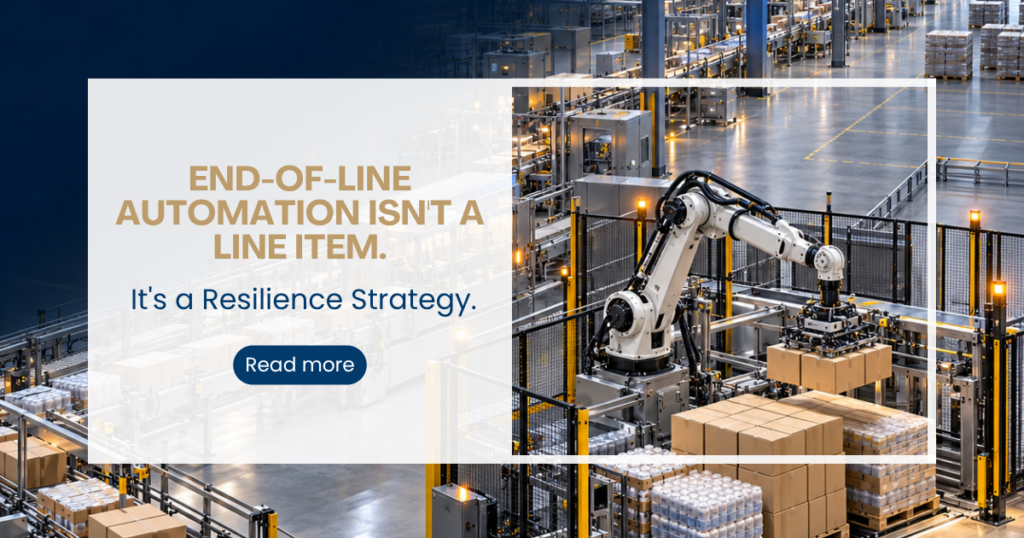
The labor problem is not temporary
For the last several years, “we can’t find enough people” has been treated as a cyclical staffing headache. The data suggests otherwise.
- 76% of supply chain and logistics operations report notable workforce shortages, with warehouse operations among the hardest hit.
- 45% of supply chain leaders already plan to purchase automated solutions, and 83% expect to adopt robotics and automation within five years.
- Gartner projects that by 2030, 50% of new warehouses in developed markets will be designed as robot-centric, human-optional facilities.
Read together, these numbers describe a market that has already made its decision. The question for most operations isn’t whether end-of-line automation happens. It’s whether it happens on your timeline, planned and funded properly, or on a crisis timeline, after the resignation letters and the missed shipments.
Palletizing is usually the first station to feel a labor shortage. It’s the most physically repetitive job on the floor, and the hardest to staff consistently.
That single point of failure has a way of cascading. When palletizing slows, everything upstream of it (filling, sealing, bagging) backs up with it, regardless of how well those stations are running.
The hidden cost of “it’s working fine”
Most end-of-line problems don’t announce themselves as equipment failures. They show up as freight claims, chargebacks, and rework that never get traced back to their real cause on the floor.
Take palletizing. Overhang and misalignment can reduce a pallet’s compression strength by up to 30%. That number rarely appears on a maintenance report. It can show up weeks later as a damaged-goods claim, after the pallet has already passed through multiple handoffs.
The same pattern appears across the line:
- Manual carton forming and sealing can create uneven quality between shifts – showing up as returns rather than a line-efficiency metric.
- Inconsistent wrap tension can let loads shift in transit – becoming a freight claim rather than a wrapping-process defect.
- Bagging inconsistency can lead to customer complaints about fill weight, long after the bag has left the plant.
These costs are rarely visible on the shop floor in real time. They surface downstream, disconnected from their cause – which is exactly why they are easy for leadership to underestimate, and expensive to keep ignoring.
Where the ROI actually comes from
When automation gets pitched purely on headcount reduction, it’s usually pitched wrong. And it’s usually the version that gets rejected in a budget review, because headcount alone rarely justifies the capital outlay on its own.
The stronger, more accurate case rests on four pillars that compound on each other:
- Consistency: automated palletizing, wrapping, bagging, and case sealing remove shift-to-shift and operator-to-operator variability – the single biggest driver of downstream damage and rework costs.
- Throughput stability: manual stations cap out at the pace of available labor, not at the pace of demand. Automated stations don’t.
- Risk reduction: fewer repetitive-strain injuries, fewer dust-exposure incidents, fewer safety events tied to manual handling of heavy or unstable loads.
- Resilience: a line that isn’t dependent on having every seat filled every shift is a line that keeps running through the labor market conditions described above.
This is also where the market opportunity sits. The warehouse automation market itself is projected to grow from $29.98 billion in 2025 to $65.74 billion by 2031, a 13.98% compound annual growth rate – a scale of investment that reflects how many operators have already run this math and landed on yes.
(Source: Mordor Intelligence, 2026.)
Why equipment alone isn’t the answer
Here’s the part of the business case that gets skipped most often: the equipment purchase is not where end-of-line automation succeeds or fails. It’s where the risk begins.
A palletizer, wrapper, bagger, or case sealer bought in isolation – without integration planning, commissioning, operator training, and a real maintenance plan behind it – tends to erode its own ROI within the first two years. The failure mode isn’t dramatic. It’s a changeover that runs long, a part on backorder with no clear lead time, or the one operator who understood the system moving to another job.
This is precisely why system integration and structured after-sales support belong in the same conversation as the equipment decision, not as an afterthought bolted on later. Hilltechs’ approach (covering conceptual design, fabrication, installation, and commissioning, backed by hands-on training and ongoing maintenance support) exists specifically to close that gap.
A framework for evaluating your own line
Before the next capital cycle, CEOs and technical directors should be able to answer five questions:
- Which end-of-line station currently sets the ceiling on our throughput, and why?
- How much of our current damage, rework, and freight-claim cost actually traces back to inconsistent manual handling (palletizing, wrapping, bagging, or sealing)?
- If our current staffing levels dropped by 20% next quarter, which stations would be first to fail, and what would that cost us?
- Are we evaluating equipment as isolated purchases, or as one connected system that has to work together?
- Who is accountable for uptime, training, and spare parts once the equipment is installed – and is that answer in writing?
Operations that can answer all five with confidence are usually the ones getting a real return on automation spend. Operations that can’t are usually the ones re-litigating the same equipment decision every two to three years.
Where to start?
End-of-line automation doesn’t have to mean replacing an entire line at once. Robotic palletizers like the Goldpack RoboPAL make sense for facilities facing space constraints, high SKU variety, or acute labor shortages. Conventional systems like the Goldpack Classical Palletizer often make more sense for high-volume, consistent-product operations where reliability and cost predictability matter more than flexibility. Automated wrapping, bagging, and case sealing can be sequenced in behind either, station by station, without stalling production.
What matters most is sequencing the investment around where the real risk and cost are concentrated in your specific operation – not around which machine looks most impressive in a trade publication.
The bottom line
End-of-line automation used to be discretionary. With three out of four supply chain operations reporting labor shortages, and half of new warehouses expected to be built robot-centric within the decade, it is quickly becoming table stakes.
The operations that treat this as a resilience and margin decision — not a maintenance upgrade – are the ones that will still be running at full capacity when the next labor-tight quarter hits. The ones that don’t will be explaining the same bottleneck to their board again next year.
Hilltechs works with manufacturing and logistics teams across palletizing, wrapping, bagging, and case sealing – and through our System Integration & Engineering After-Sales Services, on making sure that equipment keeps delivering the return it was bought for. If you’re heading into a capital review on end-of-line automation, we’d welcome the conversation.

Related posts
Robotic vs. Conventional Palletizing: Which Solution Is Right for Your Business?
Manufacturers evaluating robotic and conventional palletizing often look for a s
High-Performance Palletizing for Modern Industry: Faster, Safer, and More Sustainable
The final meters of a production line are among the most critical – and, histo
The Hidden Cost of Manual Pallet Wrapping – and the Business Case for Automating It
Why the last three minutes of your packaging line deserve a capital budget line,